


The Publishing Industry Is Having Its Barnes & Noble Moment

I love this story about Barnes & Noble, but probably not for the reason most people did.
The headline is that they survived Amazon. That's true. But they didn't beat Amazon. Amazon is still Amazon. Barnes & Noble simply stopped trying to become something it wasn't. Instead, it figured out what made it valuable in the first place and leaned into that. In the process, it found its own success instead of getting eaten alive.
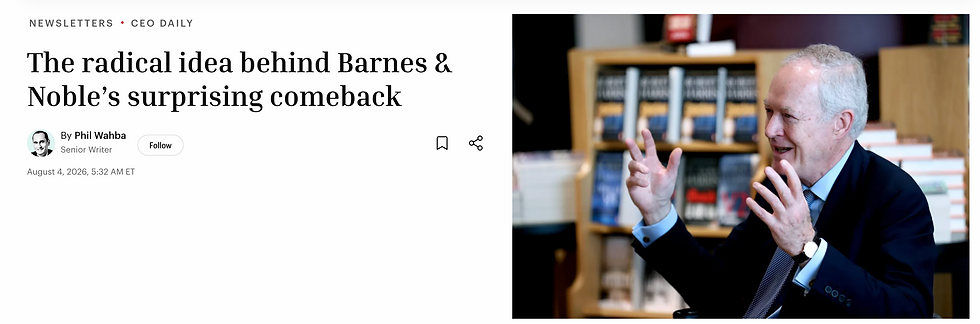
I couldn't help thinking about the changing publishing landscape.
For years, the publishing industry has acted as though there's one definition of success. Get a contract with a New York publisher. Write a 300-page book. Make the New York Times bestseller list. If you do those things, you've made it.
Says who?
Readers have never walked into a bookstore and said, "I'd really like a mediocre 300-page book today."
They want a story that stays with them. They want an idea that changes the way they think. They want to laugh, cry, learn something, or see themselves in someone else's experience. They don't care whether it takes 70 pages or 370.
One of the reasons I started Apricity Publishing was because I think we've confused the format with the purpose.
Stories belong in books. But not every story belongs in the same size book.
Some stories are complete in 80 pages. Others need 400. Adding pages because that's what the industry expects is like adding an extra half hour to a movie that was perfect at 90 minutes. Nobody leaves the theater saying, "I wish that had been longer." They leave saying, "That was great."
I also think we're hanging on to an old definition of success.
For decades, publishers were the gatekeepers. If New York said yes, you were in. If they said no, you were out.
That isn't the world anymore.
Today, readers decide.
Take Theo of Golden. It was self-published. Oprah later said her interview with the author was the best interview she'd ever done.
Helllooooo...
That doesn't happen because a publishing house blessed the book. It happens because a story found the people who needed it.
That's the business I want Apricity to be in.
Not the business of deciding whether a manuscript fits an industry formula, but the business of helping important stories find readers.
Will every book become a bestseller?
Of course not.
But I'm no longer convinced that's the right question.
The better question is whether the story got told, whether it reached the people it was written for, and whether it mattered when it got there.
Barnes & Noble didn't survive by trying to become Amazon. It survived by remembering what made it Barnes & Noble.
I think publishing is standing at that same crossroads.
Maybe it's time we stop asking every book to become the next bestseller and start helping each story become exactly what it was meant to be. - Christine Merser
*********************************************************************************************************
This is the publishing arm of Slate Spark... Do you have a book in you? Get in touch.


Comments